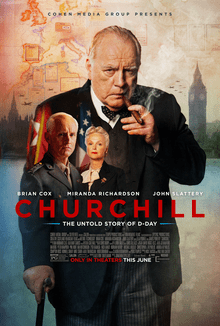
Focusing on the final days leading up to the events of D-Day, Churchill tells the story of the man, often named the greatest Briton of all time, struggling to find a voice as the powers that be prepare for the Normandy invasion. After the impact he had on the country during The Blitz in WWII and still adored by the general public, he finds himself as a bit player with senior military figures. With memories of the WWI disaster where over two hundred and fifty thousand soldiers were sent to their death in a similar gamble in the Gallipoli campaign, Churchill (Brian Cox) is against the high risk operation. He finds nothing except polite, but firm push back, the leaders of the British and US forces, Montgomery (Julian Wadman) and Eisenhower (John Slattery) are determined to push ahead, preferably with his approval but undeterred even without.

Image Courtesy Of empireonline.com
Taking more desperate measures to try and stop the potential manslaughter he even turns to long term allies such as military advisor Alan Brooke (Danny Webb) and war cabinet member Jan Smuts (Richard Durden) but he is increasingly frustrated with the lack of support and he feels like the whole country is turning against him, he even reaches out to King George (James Purefoy) for assistance at one point but struggles to gain any vocal support.
Considering the historical epic nature of the events that the movie is set to the problem with the movie was that it just didn’t feel that interesting despite the efforts of Cox who puts in a note worthy performance as a man full of self doubt internally yet still full of arrogance in public. Unwilling to bend an inch, the virtues which made him the leader he was in the early war years, are now working counter productively to his needs.
Image courtesy of dvdreleases.org
Equally as admirable is Miranda Richardson as Churchill’s exasperated wife Clementine who has stood side by side with her husband since day one and can see the error of his ways but who, despite her best efforts, cannot bring down his steely exterior.
At times it felt like you were stuck listening to an elderly relative telling you how great things were a few years back, how people had more respect then and that nobody ever listens to them anymore as Churchill spends the movie trying to strut around like he is top dog when in fact he is no longer has the relevance he once had to the military efforts and it is only through an moment of epiphany that he realises he has been battling with inner demons, which have tormented him for years, causing him to act irrationally and understand how he can best serve his country in dealing with the terror of the Nazi forces.

Image courtesy of filmjunk.com
Also, while artistic licence is one thing, changing a story slightly to improve the tale being told, it is well known, unless history books are lying to us, that Churchill, was initially opposed to the idea of a high risk, singular attack on Europe in the mid war years, by the time the D-Day landings came around he was completely supportive of the idea and contributed to the planning of the operation. Yet the movie paints this lauded historical figure as a major stumbling block for the campaign which turned the war in the Allies favour. I think it was this historical inaccuracies and seeming ignorance of historical facts, more than anything else, which ruined any prospect I had of enjoying the film.
DJ Speaks Rating: 4.5 Out Of 10
© Darren Jones 2017
 DJ Speaks Movies
Well that’s too bad.
LikeLike