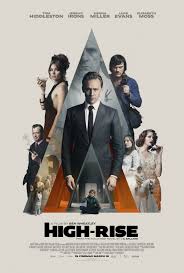
Based on a J.G Ballard novel from the 1970, High Rise is a dystopian tale of the effects on social class and human nature while in the confines of a ultra modern high rise building and stars Tom Hiddleston as Robert Laing a neurologist who moves into an apartment on the 25th floor and is soon befriended by free spirited Charlotte (Sienna Miller), his neighbour above and documentary filmmaker wannabe Richard Wilder (Luke Evans) who lives on the lower levels with his brood of children and heavily pregnant wife Helen (Elisabeth Moss).
Laing is also extended the pleasure of meeting the buildings architect Anthony Royal (Jeremy Irons) on the penthouse floor who explains the setup of the building in terms of the floor layout and amenities, he also outlines how he wanted the building to be a crucible for change and a grand social experiment. It’s during this period that he also spends some time mixing with the more affluent members of the upper floors but realises that he has nothing in common with them and drifts back to socialising with the people on his own and lower floor.
It is not long after this that Wilder becomes more and more frustrated with the treatment he, and the other members of the lower floors, are receiving as they have to deal with power cuts, broken lifts, minor food restrictions and cordoned off areas that the higher floors do not have to deal with. This escalates and Wilder becomes a figurehead for the lower floors as they begin to fight back against what they believe to be tyrannical treatment from Royal and his upper floor friends so what begins as protesting and demonstration soon descends into full scale madness as the power cuts and food shortages become more frequent and drastic. Soon the whole building is in the throes of an internal civil war, with murder, rape, drug taking and general violence all becoming the normal state of play as the whole building descends into one long orgy of violence, sex and partying with the upper floors living a lavish lifestyle to absurd levels of aloofness to the situation, that in essence they created, which is creeping towards them unstoppably. While Laing initially tries to abstain from this madness he is slowly drawn into things as the lower floors see him as a gateway to access Royal and the upper floors see him as a pawn to try and control Wilder and his followers and he is increasingly pressurised on both side until he too snaps and joins the anarchy of the situation.
Some of the problem with the movie is the amount of secondary characters who drift in and out of the movie but don’t really add anything substantial to the occurring events so you have cuts to characters who haven’t been developed properly and take away from the main players in the ongoing struggles. Also, while Laing is the middle of the struggle, on the middle floor and is, presumably, supposed to be representative of the audience as the middle ground everyman, given his job and social life he is a long way from the everyman who will watch this film so in essence there is no empathy towards his plight which leads to a state of apathy towards all of the characters and the movie in general. It’s probably more the character of Wilder who gives a closer to accurate portrait of today’s everyman, at least until his descent into madness, in terms of his standing in social structure.
There are a lot of similarities to the 2013 film Snowpiercer which was also about class war but based on a train instead, although that movie showed the classes in a more open and divided way and didn’t have as many dream sequences, but there are also moments in this movie when it echoes the anarchy of A Clockwork Orange and even the social breakdown of Lord of The Flies so while it’s far from being a bad movie, as it still had me thinking long after I had watched it, I’m still not sure if this is a satirical look at how easily human nature can be sent back to primeval ways through the loss of basic amenities or if it’s a thriller based on how the human psyche can be manipulated by pressing the right buttons at the right time or, after watching the final scenes, whether it’s all just a dream or not.
Don’t let that last paragraph put you off completely, there is some fantastic use of symbolism and metaphors all through the film, the score is excellent, in particular the use of the ABBA hit SOS but done with an unnerving twist by Portishead and the 1970’s feel of the movie is great so if you enjoy a movie that gets you thinking and is a bit off center then you will enjoy it as it certainly opens up many discussion topics, but it’s not an easy movie to watch so make sure you are in the right frame of mind for this otherwise you’ll just end up hating it and won’t give it the time is deserves.
DJ Speaks Rating: 5.5 Out Of 10
 DJ Speaks Movies